Beach Lifeguard
The NVBLQ is a national standard for beach lifeguarding. On completion of this course, candidates will have the skills and knowledge to protect the public at the beach. The NVBLQ is also endorsed by the Royal National Lifeboat Institution (RNLI), The Royal lifesaving Society (RLSS) & The International lifesaving federation (ILSF)
UPCOMING DATES:
> Course Dates:
Dublin - 02/03/04 & 09/10/11 Oct
Cork - 16/17/18 & 23/24/25 Oct
Donegal - 30/31 Oct 01 Nov & 06/07/08 Nov
“I have renewed my qualifications with Atlantic Coast Lifeguards for years now and always find the whole process from booking to finish very easy and professional. Having my lifeguard qualification has allowed me to go onto being a trainer assessor and for three years now I have been the beach lifeguard supervisor for Donegal county council, which was made possible by having optioned my NBLQ qualification all those years ago”.
Ken Keane, Lifeguard Supervisor, Donegal County Council
“We have worked with Atlantic Coast Lifeguards since 2015 to provide beach lifeguard courses for UCD students and staff, and our experience has been extremely positive throughout!”
Steven Davitt, Swimming Pool Manager, UCD Campus Sport & Leisure Ltd,
-
Be 16 years of age
Must be able to meet the following basic fitness criteria:
Jump/dive into deep water
Swim 400m in a recommended time of 7mins 30 secs
Have surfed a number of times – does not need to be proficient on their feet but be able to paddle out back easily
Swim 200m continuously on their front and back
Run at least 400m
Surface dive up to 2m
Have had previous surf lessons before coming onto the course
Ability to swim side stroke or inverted breaststroke
-
The NVBLQ covers all elements of beach lifeguard theory, cardiopulmonary resuscitation (CPR), first aid, pool skills and open water skills. The course is physically demanding and will include swimming to set times and lifting. The NVBLQ is comprised of four modules and all must be successfully passed to attain the qualification.
Module 1 – Beach Lifeguarding – Knowledge and Understanding
Module 2 – Life Support and First Aid
Module 3– Ocean Skils
Module 4 – Pool Skills
-
The NVBLQ assessment takes place at the end of the course. You can only sit the assessment if you prove competence on the course to the course trainer.
The external assessor then reaffirms your competence, skills and knowledge of working as a beach lifeguard and assesses your ability to apply the skills and knowledge in a beach environment.
The assessment is split into five elements:
Beach Lifeguard and First Aid Theory
Life Support and First Aid
First Aid Practical
Ocean Skills
Pool Skills
-
The NVBLQ is internationally recognised, so potential to work and travel.
Work within a team
Great way for students to fund studies
Learn essential life skills, including First Aid and CPR description
-
We will be in the sea for long periods:
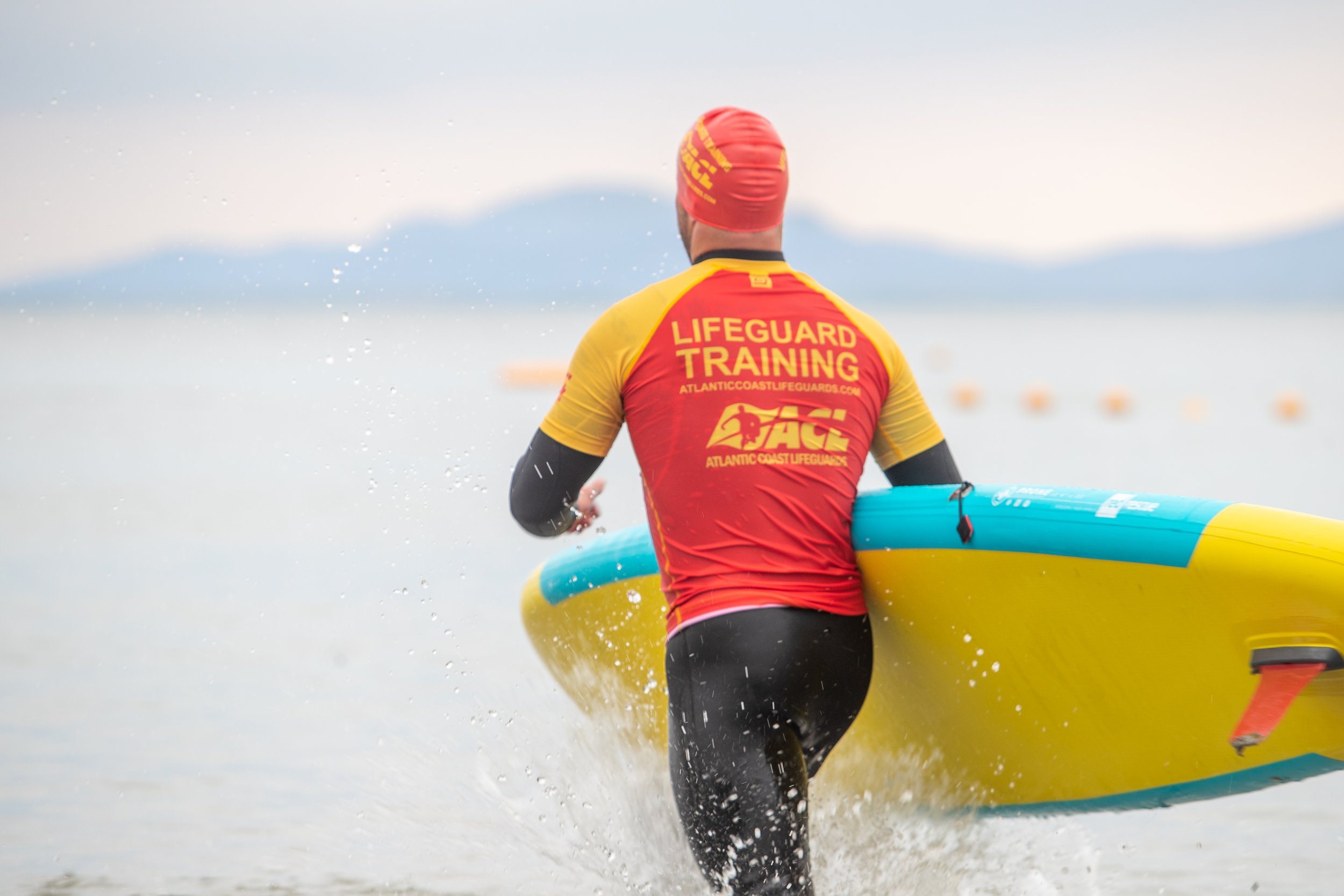
5/3 Surf Wetsuit.
Wetsuit Hood/gloves are your choice, but are advised.
Warm clothes and waterproofs, course will be outside for long periods of time.
Swim togs (no board-shorts).
Goggles can be used in pool but not at beach.
Notepad and pen for theory.
Plenty of drinking water and food (we will stop for plenty of short breaks throughout the day)
Swim Fins can be used for certain parts of open water swim, but, only if you have been doing a lot of training with them. description
-
New candidates (with no prior history with RLSS UK) will need to create a RLSS UK Account.
https://rlssuk.tahdah.me/account/registernew
Anyone who already has a RLSS UK award, qualification, or RLSS UK Membership only needs to activate their RLSS UK Account using their Society Number.
Your Society Number is on any previous certificate or correspondence from RLSS UK - it begins with a 3.
Please carefully input or check your email address to ensure you receive your account verification email. Verification is the crucial final step.
You can then log in to your RLSS UK Account and access your certificates by clicking on ‘Awards & Training’, then ‘Training’ (from the list), then finally, the green circle with a white arrow to download your certificates.
Any problems, please do not create another account; contact us at customerservices@rlss.org.uk.
-
Beach Lifeguard renewal candidates may renew their qualification within the period of validity of their existing qualification as stated on their certificate. This will include a full assessment of lifeguard knowledge and skills by an independent assessor.
Candidates must have access to the most up-to-date copy of ‘The Beach Lifeguard’ manual prior to assessment.
The following is required to be completed by candidates prior to the renewal assessment of their qualification to demonstrate their ongoing professional competence:
20 hours of Continued Professional Development (CPD) within the last two years from the date of the previous assessment covering content from the NVBLQ syllabus:
In-water swimming pool rescue skills (at least 4 hrs)
CPR (at least 4 hrs)
First Aid (at least 4 hrs)
Lifeguard theory (at least 4 hours)
Continued Professional Development can be achieved by:
Attendance at Lifeguard ongoing training and competency assessment* (strongly recommended)
Attendance at alternative training, face-to-face or online, relating to In-water swimming pool rescue skills, CPR, First Aid and Lifeguard theory
-
The course is based over two weekends and timetables is subject to change based on tide and weather. However we tend to use the following timetable.
Friday - 08.30 - 18.00
Saturday - 08.30 - 18.00
Sunday - 08.30 - 18.00
Friday - 08.30 - 18.00
Saturday - 08.30 - 18.00
Sunday - 08.30 - 18.00
This includes exam
Why become a Beach Lifeguard?
As a Beach lifeguard from your work you will gain life experiences, meet likeminded people, get good rates of pay, learn lifesaving skills that stay with you forever, train & become a fitter, healthier you & travel the world with an international qualification.
Why This Course Is Challenging?
A Physically Demanding but Rewarding Course
Lifeguarding requires physical fitness, strong swimming ability and the ability to make quick decisions in high-pressure situations. This course is designed to reflect real working environments and includes intensive practical training both in the pool and open water.
Candidates should expect:
Daily swimming and rescue drills
Training in varying weather and sea conditions
Continuous assessment throughout the course
The goal is not just to pass an exam, but to develop confident and capable lifeguards.
What You Will Learn During the Course
This course goes far beyond simply achieving a qualification. It focuses on developing the judgement, physical ability and knowledge required to operate safely in real beach environments.
Training includes:
Reading tides, swell and beach conditions
Understanding wind, currents and rescue routes
Personal safety and water defence techniques
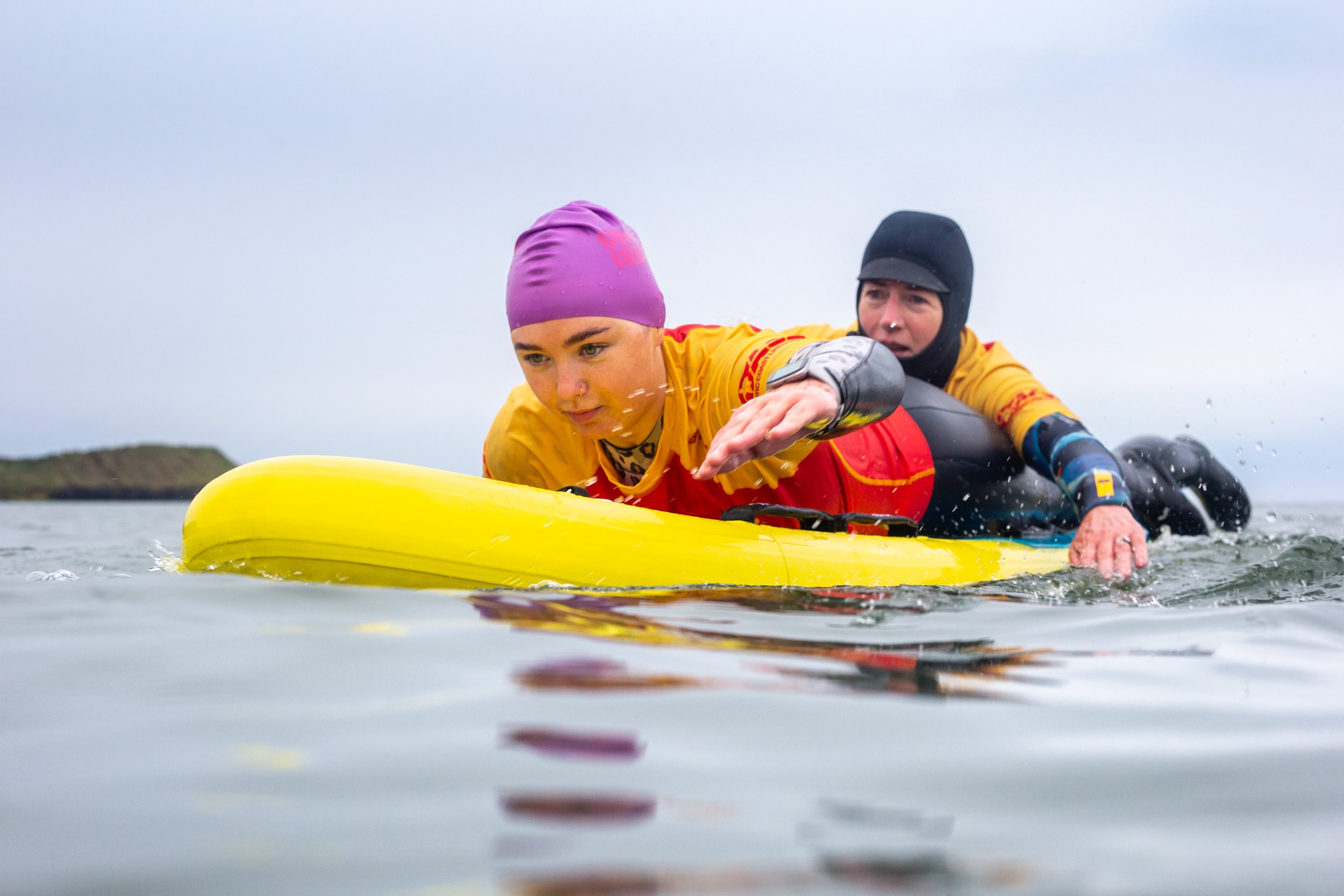
Rescue board skills and manoeuvring in surf
Casualty management and beach first aid
CPR and emergency response procedures
A key part of lifeguarding is recognising risk early. Often the rescuer is the person most at risk during a rescue. Our training focuses heavily on situational awareness and decision-making so candidates learn how to manage incidents safely and effectively.
FAQs
-
To start the beach lifeguard course the minimum swim fitness allowed is to be able swim 400 meters front crawl, non stop in under 7 minutes 30 seconds
-
The NVBLQ course is a minimum of 40 hours long followed by a practical assessment on beach theory, life support, first aid, swimming pool practical and open water practical.
-
While you do not need to be profecient at standing on a surfboard, you do need to be able to paddle a board through breaking waves and be able to catch waves easily on a surf board
-
We will be in the water daily for a number of hrs and for you to be safe you need to wear a winter surf wetsuit of minimum thickness 5/3. You also need to wear surf booties for protection of your feet.
-
16 is the minimum age for our public courses
-
Accredited national beach lifeguard certificate from Royal Lifesaving Society is valid for 2 years from date of completion of exam.
-
Improve your communication skills. ...
Increase your self-confidence. ...
Develop sought-after skills. ...
Learn life-saving skills. ...
Make new friends. ...
Fancy a challenge?
-
On completion of a course and final assessment you get your certificate immediately via our online portal
-
Goggles are allowed during the 400 meter swim fitness test, but no other part of training.
-
I am new to RLSS …
If you have never held a RLSS award, qualification or RLSS membership, you do not have an account and will need to create one. Creating your RLSS Account is easy. Just click the link below and, don't forget, shortly after setting up your RLSS UK Account you will receive an email from us asking you to verify your email (check your junk/spam inbox). This is the crucial final step and, then you are good to go!
https://rlssuk.tahdah.me/account/registernew
Health and Safety on Courses:
Due to the nature of the course candidates will be required and be aware of the following:
-
To lift and move candidates from the water as part of a team – correct methods of lifting will be taught but we should be informed of any pre existing injuries prior to the course starting.
The following statement should be read to candidates at the commencement of both training courses and assessments:
“The Society does not support the use of unassisted lifting during training and assessment. You should take note that all casualty lifting carries with it an element of risk.”
-
Ear damage may result from diving to depths greater than 1.5 metres. All candidates must be warned of this prior to training by trainers & prior to assessments by assessors.
The following statement must be read to all candidates:
“YOU SHOULD BE AWARE THAT THERE MAY BE A RISK OF DAMAGE TO YOUR HEARING BY DIVING TO DEPTHS GREATER THAN 1.5 METRES. ALL DIVES ARE UNDERTAKEN AT YOUR OWN RISK”.
Any candidate with a history of ear trouble should not be permitted to dive without previously consulting a medical practitioner. If the minimum depth of water available is greater than the maximum depth laid down in the test conditions, the Assessor will check the candidate can execute a surface dive and swim down to the depth specified in the test conditions to recover a suspended object from the stated depth. NPLQ candidates must recover a submersible manikin.
-
Candidates are advised that Lifesaving, Lifeguarding and Life Support activities involve physical handling and manoeuvring of bodies. Jewellery which may cause damage must be removed on the instructions of the Trainer or Assessor.